By default, DocFusion inherits date-time and number formatting from the ISO specification for your selected culture. You can also customize any of these settings to suit your input data. Any settings that haven't been customized will continue to use their standard ISO definitions.
Global settings apply to all templates in your business unit, and are configured using DocFusion Workbench. It is important to note though that global customizations to culture are subject to an order of precedence.
In this guide, you'll learn how to access your global culture settings and customize both date-time and number formats.
Steps
1. Access global culture settings
First, open DocFusion Workbench and login.
Next, select your Business Unit from the tree in the left pane, and then navigate to the Repository menu. Click the Properties command to open the Environment Properties dialog.
If a global culture has been previously set, it will be selected in the Culture field. You can default it to the server locale settings by clicking Reset. Alternatively, proceed to the next step to customize your culture settings.
2. Select the culture
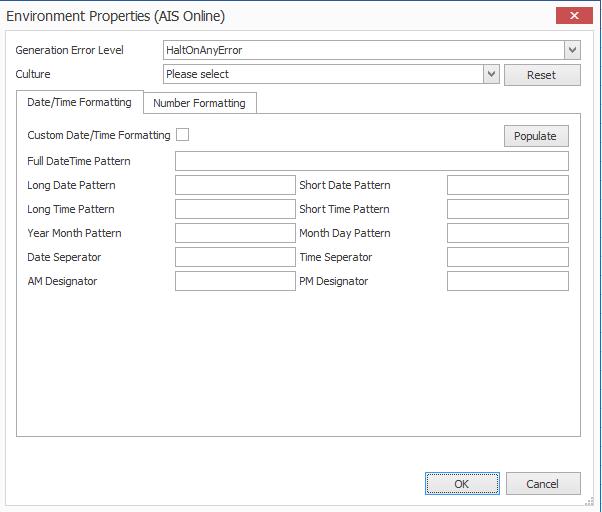
The Culture dropdown presets a list of ISO standard cultures. Select the one that you would like to use. The ISO codes and descriptions alongside will help you to identify the correct one. Any culture selection you make can be customized, though that is optional.
Once you've selected a culture, click the Populate button. It displays all the standard ISO date-time and number formats associated to the culture that you have selected in their respective fields.
If you simply want to continue using the standard ISO culture specification, then click OK. This dismisses the dialog and your chosen culture will be used as the global setting for all templates in your business unit.
If, however, you wish to customize the standard ISO specification, then proceed to the next step.
3. Customize formats
Always click the Populate button before customizing any settings to ensure that the standard ISO definitions are used as a fallback for fields that you don't customize.

To Customize Date/Time Formats:
First, ensure that the Date/Time Formatting tab on the Environment Properties dialog is selected.
Now, instruct DocFusion to override default format settings by enabling the Custom Date/Time Formatting checkbox. This enables the fields for input.
Now edit any of the date/time settings as needed. You need not customize all of them, but it is important to note that fields without values assigned will generate as blanks in your document. To ensure this doesn't happen, always click the Populate button before making any customizations. This defaults the values that you don't customize to the standard ISO definitions for your selected culture.
To Customize Number Formats:
Navigate to the Number Formatting tab on the Environment Properties dialog.
Now, instruct DocFusion to override default settings by enabling the Custom Number Formatting checkbox. This enables the fields for input.
Now edit any of the number settings as needed. You need not customize all of them, but it is important to note that fields without values assigned will generate as blanks in your document. To ensure this doesn't happen, always click the Populate button before making any customizations. This defaults the values that you don't customize to the standard ISO definitions for your selected culture.
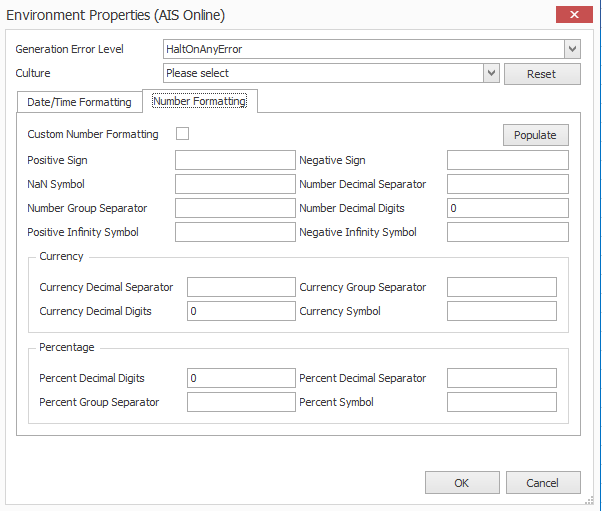
Once you're done, click OK to save and apply your customizations. This dismisses the Environment Properties dialog.